Question 1: Do you think the primary purpose of business should be maximizing shareholder profit, or creating value for multiple stakeholders? Explain your reasoning.
I think the answer lies in a realistic balance of the two. Like the reading mentioned that economists like Milton Friedman argued that a business’s social responsibility is simply to increase its profits. However, the stakeholder perspective suggests that responsibilities extend to employees, communities, and the environment. For me, a business needs to be maximizing shareholder profits, but at the same time, it must make sure it is maintaining value for all stakeholders involved without bringing detriment to anyone. That balanced approach is what I feel the primary purpose of a business should be.
Question 2: Given current trends (e.g., ESG reporting, consumer expectations, and regulation), do you think purpose-led business is becoming a necessity rather than a choice? Why or why not?
Yes, ideally speaking, I think purpose-led business is becoming an absolute necessity. Modern consumers and employees increasingly expect companies to contribute positively to society, which is accelerating this shift. In my view, any business that doesn’t have a purpose simply shouldn’t be a business. However, I will add that the “purpose” of a business might not necessarily have to be tied strictly to an environmental drive; it can just be about having a specific, focused goal for growth and what they want to accomplish in their specific market.
Question 3: Which of the three styles—giver, matcher, or taker—do you most identify with in your academic or work life? How has this influenced your relationships and outcomes?
I identify mostly as a “giver” and sometimes try to be a “matcher.” In my work, academic, and general life, I tend to give a lot of my time and energy. Honestly, sometimes this has a detrimental effect on me, as givers without boundaries can sometimes be taken advantage of.
Despite this, it has definitely influenced my relationships and outcomes in positive ways. Because I give freely, I am a much more outgoing person and find it easy to connect with people from all over the world. As for outcomes, while some have tried to take advantage of me, I have also found that giving without expecting anything in return often yields high-impact results like an unexpected referral or someone stepping up to help me when I need it most.
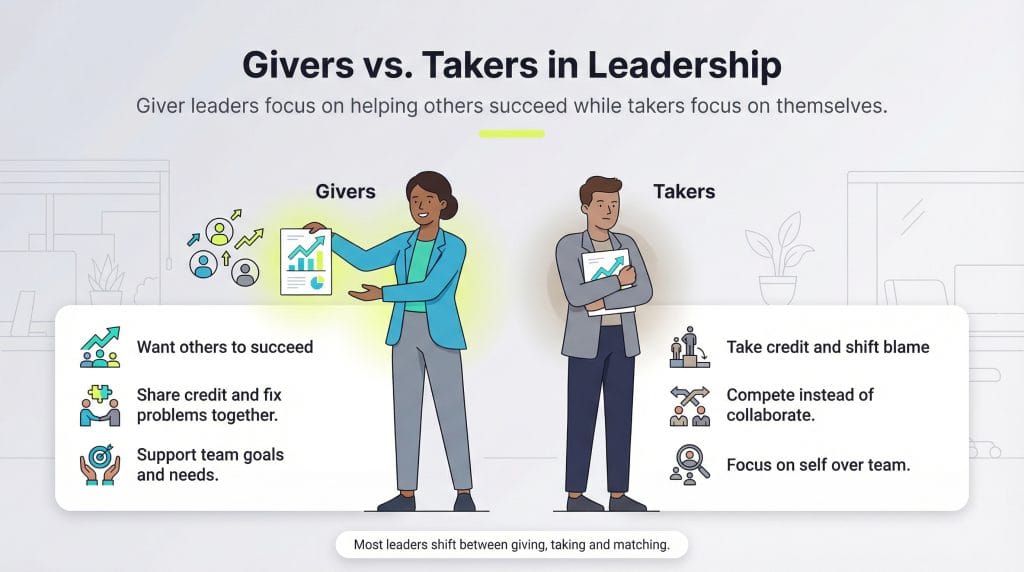
Question 4: As a future leader, how might you apply a “giving” approach while still maintaining boundaries and avoiding burnout? What might this look like in a real workplace setting?
I think It’s very hard, but to become what the reading calls an “otherish giver” that is someone who contributes while maintaining clear priorities —the clear approach is evaluating the impact of your actions. Before giving or taking on a new burden, I need to ask: Does this have a serious detrimental effect on me or the business? If not, I can apply a principle of tolerance and give people chances. In a real workplace setting, this looks like giving an employee the grace to learn and make mistakes on a task. However, to maintain boundaries and limit bad actors from taking advantage, I would set clear limits. If an employee is not keeping up with workplace standards after being given a fair chance over a period of time, definitive action must be taken.

Question 5: The SET model suggests that businesses should prioritize social and ecological well-being over profit maximization. Do you agree with this shift? Why or why not?
I do not necessarily agree with the shift to prioritize social and ecological well-being over profit maximization. I think there has to be a balance, and I generally believe that businesses should try to maximize profit first. The Financial Bottom Line approach focuses heavily on profit, and I believe that fulfilling this fiduciary duty provides the necessary foundation for a business to survive.
Ultimately, it is only when a business generates enough profit and has a strong financial footing that it actually has the resources to sustainably invest in social and ecological well-being. A business must ensure it can continue to operate long-term; once that is secured, it can reinvest those resources into Corporate Social Responsibility (CSR).
Question 6: What outcomes do you think would emerge if there were a large-scale shift toward businesses operating using the SET model? What might this look like for employment, workers, communities, and the ecological systems in which businesses operate?
If there were a large-scale shift, I think it would be highly beneficial for businesses that adopt more human and sustainable practices. The reading notes that organizational cultures operating under this model prioritize meaningful work and equity. The primary outcome I foresee is a general improvement in stakeholder satisfaction. This would positively impact everyone from employers and employees to the surrounding communities, creating a much healthier environment to operate in.

Question 7: Reflect on a recent purchase you made. Did it provide lasting satisfaction, or was the benefit short-lived? How does this relate to the idea of the hedonic treadmill?
For a while now, I have embraced the concept of minimalism that is the idea that less is more, and that satisfaction comes from what you have rather than what you lack. Because of this, most of my recent purchases provide lasting satisfaction, or they are strictly based on basic needs (like food), which aren’t meant to provide philosophical fulfillment anyway.
The reading defines the hedonic treadmill as a phenomenon where individuals quickly adapt to new possessions and lose satisfaction, driving a cycle of continuous consumption. I understand this concept, but because I have made a conscious mindset shift, my purchases are intentional, and I actively avoid getting trapped on that treadmill.
Question 8: How do you feel about your current consumption habits? Do they align with your values? If not, what changes would you like to make, and how could you start?
As I mentioned above, my current consumption habits are very minimalist. I always factor purchases based on what I need, not what I want. This aligns with the broader shift mentioned in the text: asking “What do I actually need to live well?” rather than focusing on acquiring more. I also practice delayed gratification; if I know something is just a “want,” I delay the purchase. I feel very confident and reflective of my habits, and they strongly align with my core values of simplicity and being less consumerism-driven.

Question 9: Can you think of an example where people working individually or together created positive change? What does this tell you about the potential for impact?
A great example is the rise of local “Buy Nothing” community groups, where neighbors gift items they no longer need instead of throwing them away. This perfectly illustrates how collective shifts in behavior can influence systems and culture. It tells me that massive impact doesn’t always require global legislation; everyday actions, when compounded by a community, can drastically reduce waste and build stronger local networks.
Question 10: When your actions align with your values, how does that feel? What is one action you could take to move toward that alignment in your own life?
When your actions align with your values, it is an incredibly fulfilling and ecstatic feeling. I have experienced this personally by unlinking my internal happiness from material possessions.
The reading notes that change begins with awareness and everyday actions. One action I took to align my life with my minimalist values was simplifying my wardrobe to wearing plain t-shirts. For a long time, I worried about the social pressure of people thinking I was wearing the same clothes repeatedly a side effect of how marketing links possessions to social status. But once I committed to it, I found it incredibly liberating. It keeps true to my value of simplicity, and I don’t have to worry about the endless cycle of keeping up with trends.